English 576 History and Theories of Rhetoric Fall 2012
MW 8:30 - 9:45 LCH 221
Instructor: Dr. Randy Cauthen
ccauthen@csudh.edu
[310] 243-3931
Office: LCH B332
Office hours: MW 1-2:30, 5:30-6:30, and by appointment.
Course web page: http://www.csudh.edu/ccauthen/576F12/index.htm
Course Description
I have often and seriously debated with myself whether men and communities have received more good or evil from oratory and a consuming devotion to eloquence. -- Cicero
But put identification and division ambiguously together, so that you cannot know for certain just where one ends and the other begins, and you have the characteristic invitation to rhetoric. -- Burke
How could I adequately explain that rhetoric had not always been a synonym for public flummery and outright lying? That the modern university subjects had spun out of a rhetorical center not much more than one hundred years ago? That for two millennia rhetoric had been at the heart of Western education, had supplied its traditional unity, the lack of which we now so deplore? That it was rhetoric which, for most of Western history, had shaped the basic curriculum that taught people how to read, write, and think? -- Richard Lanham
If you use crummy words, people'll think you're a creep. -- Wally Cleaver
The primary goal of the course is to trace the history of rhetoric from its
origins in classical Greece and Rome through its Medieval, Renaissance, and
Enlightenment permutations to its modern manifestations. Of equal importance
will be analyzing rhetoric in any era in terms of its importance to composition
study: How does this material have applicability in the writing class? Which
parts can we draw upon and how? As English teachers, we definitely need to know
the history of our profession provided by the history of rhetoric, but we also
need to know what the past tells us, if anything, about contemporary pedagogical
problems.
This is a seminar, a discussion based course; it is not a lecture course. What
we learn will be driven primarily by the questions, comments, ideas, and
energies that you bring to our discussions. In other words, we will learn about
texts by actively engaging them and each other in our regular meetings. Our
class can't really function if there isn't student participation -- it will
become just me giving an ad lib lecture for 75 minutes, which will be horrible
in all kinds of ways, trust me. There is, therefore, a fairly large percentage
of the final grade that will concern the quantity and quality of your
participation in class discussions. If you are cripplingly shy, please discuss
this requirement with me; we will find some way for you to fulfill the
requirement, mitigate your shyness, and demonstrate your mastery over the
material.
The amount of reading assigned in this course, for a graduate seminar, is quite low. Please read the material carefully, take notes on it, and be prepared to discuss it thoroughly for each class session. Don't make me give reading quizzes.
Required Texts and Materials
Herrick, James A. The History and Theory of Rhetoric: An
Introduction. 4th ed.
Plato,
Phaedrus, Penguin Classics edition.
A
hardbound journal/composition book
Handouts and web links as listed below -- PLEASE NOTE you are responsible for
printing these off and bringing them in for discussion.
Prerequisites
Permission of instructor and Department Chair.
Learning Outcomes
By the end of the semester, successful students will
1. Think like rhetors: that is, be
able to analyze and use a variety of persuasive techniques in a variety of
communicative contexts.
2. Demonstrate familiarity with a range of histories and theories of rhetoric
from the classical period through the twentieth century.
3. Demonstrate familiarity with important issues in current composition theory,
and the ability to connect these issues with major rhetorical theories.
4. Present, explain, and analyze major positions in rhetorical theory.
5. Demonstrate mastery of the course material as a whole and practice study and
writing strategies for the graduate comprehensives by writing a timed,
comprehensive final exam.
Course Requirements and Grading
A. Class Participation/Discussion/In-class writing: 25% of final grade. This grade will be assigned according to the
following rubric based on both how much and how well you participate in the
discussion, on the 13-point scale listed below, under A Grading Scale for
Written Work. Representative points on this scale are as follows:
13 = always participates cogently in
discussion; clearly has been diligent with the reading
12 = almost always participates cogently in discussion; clearly has been
diligent with the reading
10 = usually participates cogently in discussion; clearly has been diligent with
the reading
8 = sometimes participates cogently in discussion and/or appears to be less
diligent with the reading
4 = seldom participates cogently in discussion
0 = never participates cogently in discussion
I'll give you an interim grade on your participation at the beginning of October and November (see Schedule, below).
B. Short paper (3-4 pages). I will supply you with possible topics for this paper; you are also welcome to come up with your own topic if you consult with me first. 15% of final grade.
C. Course Journal. You're responsible for one informal journal writing each week. Some of the things you can do in your journal are:
1) analyze the rhetoric of a text (not necessarily a written one) using the concepts we learn from the reading;
2) discuss the possible pedagogical uses of a particular concept in the reading;
3) discuss connections and tensions between various texts we've read;
4) use some of the techniques of invention, arrangement, and style discussed by the authors we read to develop a brief text of your own.
I'll ask each of you to present, briefly, a rhetorical analysis of a particular text (that is, something from category 1 above) in class. The journal counts as 15% of final grade.
D. Rhetorical analysis of 2012 Presidential Election (6-8 pages). In this project, you will use the concepts we discuss in class to analyze a particular text from this year's election: an advertisement, speech, an editorial, etc. A sample title might be something like: "A Burkean Reading of Obama's Convention Address." More guidance, and in-class practice, is forthcoming. 20% of final grade.
E. Final Exam. 25% of final grade. More guidance on this is forthcoming. The exam will cover the materials from the course as a whole, and will be a timed bluebook exam. You may use your class notes in writing the exam, so take good ones.
The first paper may be revised and resubmitted for a higher grade.
Grading Scale for Written Work
For reasons of precision, I grade with numerals and decimals instead of letters
and operators.
The scale and equivalents go like this:
13 = A+ = Mind-blowingly good.
12 = A = Extremely good.
11 = A = Very good.
10 = B+ = Good.
9 = B = High average.
8 = B- = Low-average.
7 = C+ = Noticeably subpar.
6 = C = Severely subpar.
5, 4, 3, 2, 1 = Direly poor -- we need to talk.
0 = No credit.
Grading Scale for converting the final numbers back to letter grades:
93-100 A
80-82 B- 67-69 D+
90-92 A- 77-79 C+ 63-66 D
87-89 B+ 73-76 C 60-62 D-
83-86 B 70-72 C-
below 60 F
Course Schedule
Readings are due on the dates listed; that is, you should have them read
and considered, and have done at least a little brainstorming about ways to
discuss them, by the beginning of class on that date. Some of these readings
I'll be providing for you free, online or on disk; please print these readings
out, read them, annotate them, and bring them with you on the night they're due.
8/27
Introduction to Course. Introduction to
Rhetorical Analysis;
part 2. A reading process for difficult texts.
8/29 Pathos.
Herrick, Ch. 1;
Winterowd, pp. 11-13; Roberts-Miller,
"How to do a Rhetorical Analysis". Martin Luther King, Jr.,
"I Have a Dream":
video,
text,
word cloud, materials for teaching the speech to
seventh-graders, discussion
questions.
9/3
Labor Day -- No Class
9/5 Campaign Rhetoric
2008: Frank,
Parry-Giles. Obama: "A
More Perfect Union." Ads: McCain: Love,
Celeb; Obama: The
Country I Love.
Discuss journal #1.
9/10
Herrick, Ch. 2; Gorgias, "Encomium
of Helen"; Winterowd, pp. 27-30.
9/12
9/17
Herrick, Ch. 3; Winterowd, pp. 14-24.
Discuss journal #2.
9/19 Plato,
Gorgias (excerpts)
9/24
Plato, Phaedrus, pp. 3-39 (end of b5). Discuss journal #3.
9/26 Phaedrus, pp. 39-68.
10/1
Herrick, Ch 4; Winterowd, pp. 24-27; Bring in a paper
topic or two for your first paper.
10/3 Paper
topics. Aristotle, from Rhetoric; Herrick, Ch. 5.
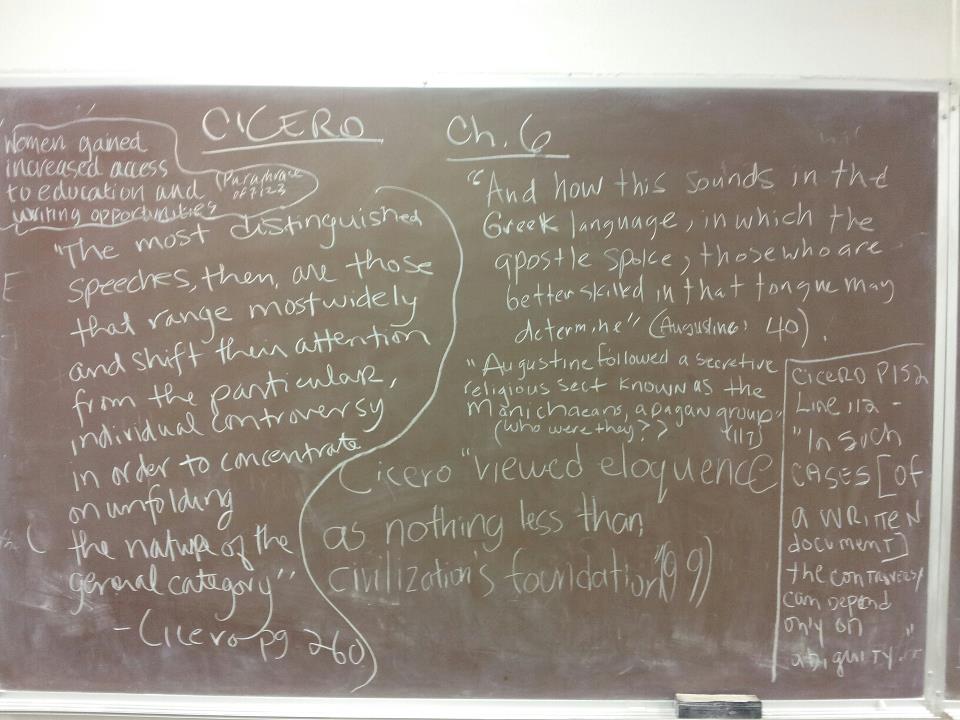
10/8 Cicero, from On the Orator.
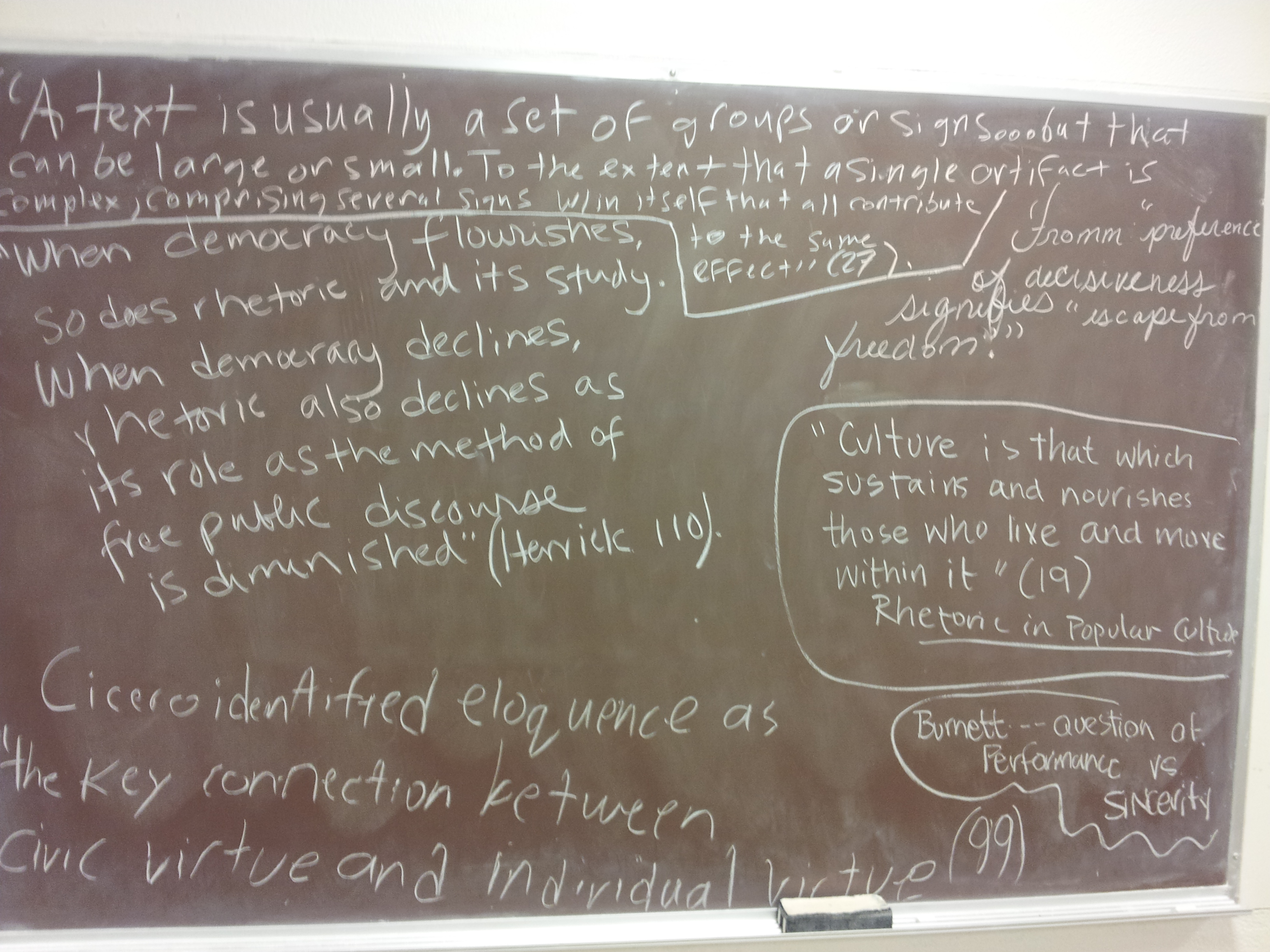
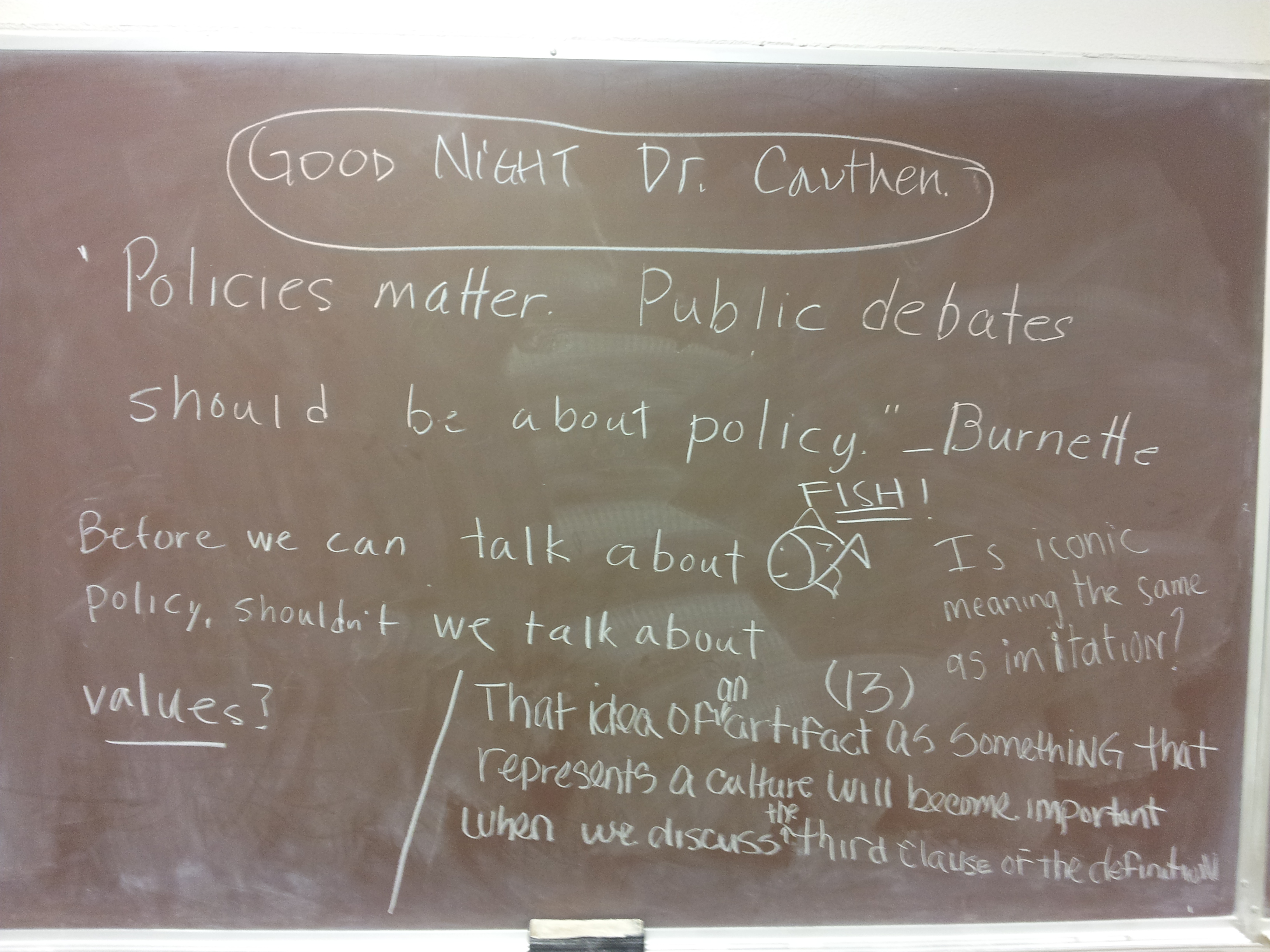
10/10 Burnette; Brummett, from Rhetoric and Popular Culture. Discussion questions.
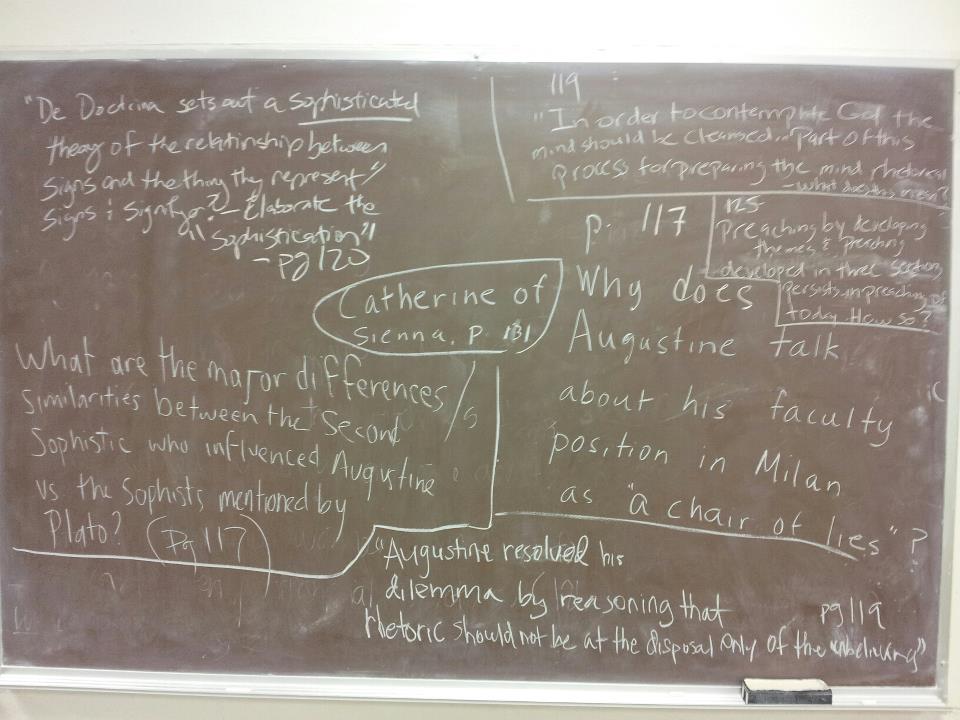
10/15 Herrick, Ch. 6; Augustine, On Christian Doctrine, Book 4.7, 4.19-28. Discussion questions.
10/17
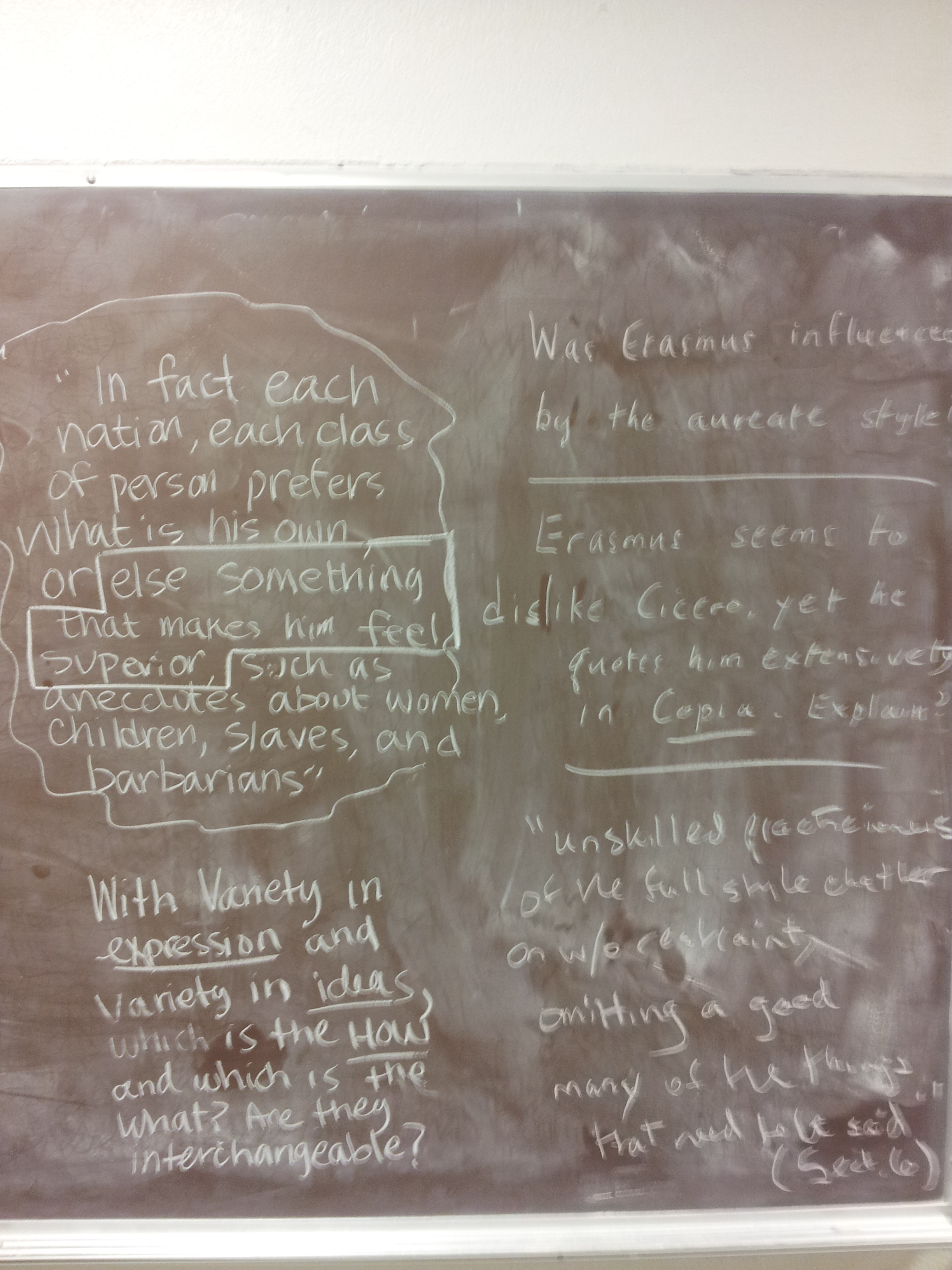
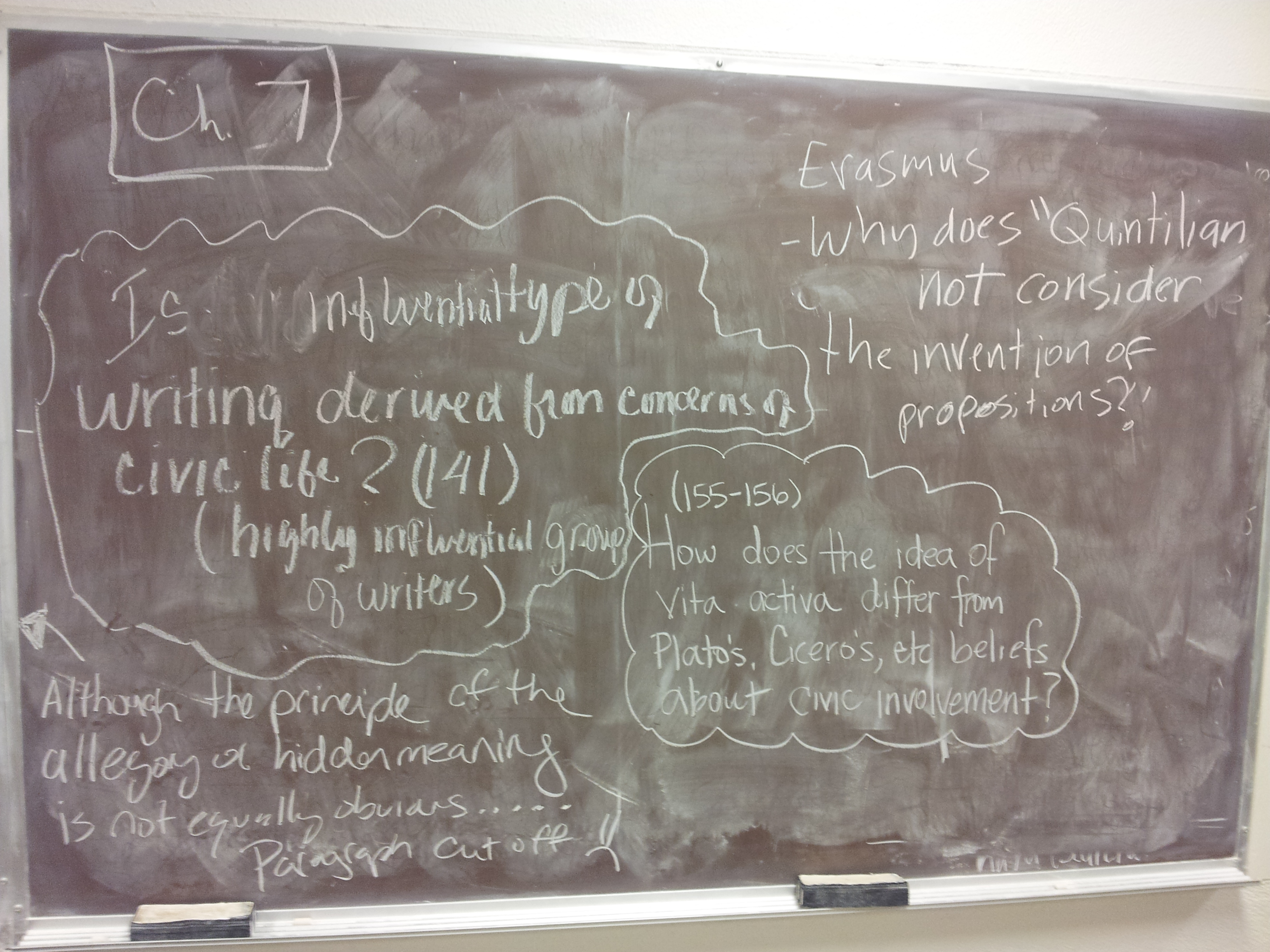
Herrick, Ch. 7; Erasmus, from Copia. Class discussion interim grade 1. Discussion
questions.
10/22 Herrick, Ch. 8; Winterowd, Ch 2.
Paper One due
10/24 Nietzsche, "On Truth and Lies in a Nonmoral Sense"
10/29
Herrick, pp. 189-196; Ch. 10
10/31 Winterowd, Ch. 4, Foss, "Pentadic Criticism"
11/5 Burke, "The Rhetoric of Hitler's Battle."
11/7 Herrick, Ch. 11; Winterowd, Ch. 6
11/12 Veterans' Day -- no class
11/14 Foucault, from "The Order of Discourse"
11/19 Cixous, "The Laugh of the Medusa." Class discussion interim grade 2
11/21 Conferences
11/26 Schuster, "Mikhail Bakhtin"
11/28
Gates, "The Signifying Monkey and the Language of Signifying"
12/3 Anzaldúa, from Borderlands/La Frontera
12/5 Frankfort, "On Bullshit"; Fish, "Rhetoric."
12/12 8-10 p.m. Final Exam Sample Exam Questions
Rhetorical Analysis Due
Course Policies
1) The drop deadline is September 13. Please decide your status by then as
I don't normally approve drops after the deadline and require documented
"serious and compelling reason." A medical emergency or permanent change in work
schedule is adequate reason; a failing performance or frequent absence is not.
Be aware that Incompletes won't normally be issued.
2) Please bring your book and/or
printed-off handouts to class every day -- we'll need them for the assignments
and discussion.
3) Extremely important: You are required to do every last iota of the reading and writing assigned, exactly in the format requested, and it needs to be totally done by the time class starts. There is no such thing as "falling a little behind" in the course reading; either you've done your homework or you haven't. Chronic lack of preparation (which is easy to spot) will lower your participation grade, and therefore your course grade, considerably.
4) Writing for this course is public writing. You will be reading each other's papers in workshops, and I may use certain papers (anonymously) as sample papers in this class or in future classes. Don't write anything that you feel is overly personal or would embarrass you to have someone know.
5) Extremely important: If you have any problems or questions concerning the class, please let me know immediately. We can solve most of these problems, given time, but last-minute notification tends to make solving problems impossible. If you can't make my office hours, call, e-mail, or see me in class and we can make other arrangements.
6) Attendance: Since this class is a seminar, attendance and participation are essential. After one unexcused absence, each additional absence will lower your final course grade by 5%.
7) Plagiarism and Academic Integrity: I want to emphasize how important it is that you learn by doing your own work. If you are tempted to submit another's work as your own, you should know that it's not worth it; if you're desperate as a paper deadline approaches, talk to me and we will explore possible options. The University policy on Academic Integrity reads in part: "At the heart of any university are its efforts to encourage critical reading skills, effective communication and, above all, intellectual honesty among its students. . . . Plagiarism is considered a gross violation of the University's academic and disciplinary standards. Plagiarism includes the following: copying of one person's work by another and claiming it as his or her own . . . or the presentation of some one else's language, ideas or works without giving that person due credit." The statement defines academic integrity in some detail, and you are responsible for following it; it is printed in the University Catalogue. Plagiarism or any other form of academic dishonesty will result in your failing the course and in my invoking the Student Disciplinary Process. I will not excuse any form of academic dishonesty and will always report it to the appropriate authorities. Please see me if you have any questions.
8) Any additional handouts or assignment sheets given out in writing constitute a continuation of this syllabus. This syllabus is subject to revision by the instructor.
9) Lateness policy: Late work will be docked 2 points (on the 13-point scale above) for every period late, except given documented medical circumstances.
10) This class welcomes students with disabilities. By law, disabled students are entitled to accommodations, either in- or outside of class, that will allow them to complete assignments. The Disabled Student Services (DSS) program makes all of the University's educational, cultural, social, and physical facilities and programs available to students with disabilities. It is the responsibility of the student to have a complete DSS file. It is also the student's responsibility to request specific accommodations from DSS in a timely manner. For more information, visit their web page or their office in Welch Hall 180, or call 310 243-3660.
11) If I see you texting or doing other phone or computer stuff (except for activities I have clearly sanctioned), you'll be counted absent for the day. See Attendance Policy, above. Exhibits A and B. Also consult the Buddhist concept of shikantaza.