Instructor: Randy Cauthen
Office: LCH B336
310.243.3931
Office Hours: M 2:30-5; W 11:30-1
Required Text and Materials
Janet Burroway,
Imaginative Writing: The Elements of Craft, 3rd Edition
A small, hard-bound journal
Miscellaneous other readings to be posted to the web. You need to
print off and bring in these readings for class discussion on the days
they are due.
Prerequisites
English 111 (Composition
2) and permission of instructor.
If you haven’t taken Composition 2, or if you aren’t sure, see me
immediately – you may be in the wrong class.
Course Description and Objectives
With effort on your part, this course will improve your skill in writing serious, contemporary, adult (as opposed to children's and young-adult, not as opposed to fully-clothed) fiction, poetry, and drama.
Writing is learned by doing it, getting feedback, revision, and reading the best writing that's been done before. The main focus for this class will be your own writing. We’ll also work extensively in class with exercises and techniques for developing ideas for writing. But as well as improving your skills in writing poetry and fiction, you will also develop critical skills through discussing your peers’ work; in turn, these critical skills will be useful in giving you a more objective attitude toward your own writing. We will read a good deal of contemporary fiction and poetry AND I will also strongly encourage you to read the literature of previous periods. Writers who are serious about writing poetry or fiction must also be serious about reading and studying literature; good writers have always cared deeply about, formed their standards on, and tested their ideas against, the best that has been written in the past.
Learning Outcomes
By the end of the semester, students will
Practice brainstorming,
journaling, and other means of developing material;
Familiarize themselves with many of the most common themes and
techniques in contemporary literary fiction, poetry, and drama;
Develop both critical acumen and diplomatic skill in critiquing the
work of their peers;
Develop a substantial body of written and re-written work.
Course Requirements and Grading
1. Weekly Drafts. You’ll be asked to forward a poem or short story to your workshop group every week, with a firm deadline of Wednesday noon, starting February 22 -- this gives you about a month to start working on your drafts. You’ll turn in drafts every Wednesday and workshop every Monday for the remainder of the semester; in class on Wednesdays we’ll do journal exercises, discuss readings, read our own work aloud occasionally (see below), occasionally have writers in as guests, etc., etc.
 Don't fail to turn in a
draft every Wednesday. For the record, I end
up printing out everything that comes in to my mailbox by deadline. If I
don't have it, it's counted as (at best) late, which effects people's
final grades in the course. If you don't have something
"finished," that's fine - turn in something
unfinished/experimental -- you'll be asked to revise most of your work
anyway. If you don't turn in anything, though, your grade
will suffer.
Don't fail to turn in a
draft every Wednesday. For the record, I end
up printing out everything that comes in to my mailbox by deadline. If I
don't have it, it's counted as (at best) late, which effects people's
final grades in the course. If you don't have something
"finished," that's fine - turn in something
unfinished/experimental -- you'll be asked to revise most of your work
anyway. If you don't turn in anything, though, your grade
will suffer.
Poets will be expected to submit a total of 10 poem drafts; prose writers will be expected to submit a total of four drafts of separate works; those working in both genres will submit an equivalent ratio in each genre.
You will be graded partly on your ability to vary your approach: to experiment with different styles, themes, and strategies. My justification for this is that experimenting and attempting different types of work is an essential part of any writer’s growth. If you end up turning in very similar things week after week, your grade isn’t going to be very good.

2. Portfolio. The major part of your grade, this is the “substantial body” of writing mentioned above. The final portfolio should include the first drafts (as presented to your workshop group throughout the semester) with my comments, and revised drafts of at least 2/3 of this material. (This means that you need to hang on to the drafts you receive back from me.) These revised drafts should show evidence that you have taken into account (NOT necessarily followed, but considered) the critiques you’ve gotten from your workshop group and from me. The portfolio is due on Monday of Exam Week, May 14. 60% of final grade.
3. Journal. This will contain exercises, starts and stops, descriptions/observations, ideas for future writing, etc. I’ll also ask you to respond to the works of professional writers that we’ll read. Keeping a journal is one of the most important ways that writers develop material. Use a sturdy notebook or hardback journal, one that you can take with you easily (it’s no good to you when it’s not there), and one that will be comfortable and easy for you to use. We'll do a lot of journaling in class, but I'll also occasionally ask you to do some out-of-class journaling. 20% of final grade.
4. Peer critique. I’ll grade you on your ability to be both diplomatic and helpful in your responses, and we will practice and discuss what constitutes a helpful response. For your grade, I will be looking primarily for improvement of your responses. For workshop days, print off your fellow students’ work and bring it in for discussion; failure to do so will lower your grade in this area. Give your written comments to the student who wrote the piece; that student will then be responsible for turning in those comments to me. 10% of final grade. Don't just read the work off of your phone screen -- print it out and write on it.
5. Reading Quizzes. 10%
of final grade.
Course Policies
1. Please bring your book and your journal to class every day – we'll need them for the assignments and discussion.
2. : If you have any problems or questions concerning the class, please let me know immediately. We can solve most of these problems, given time, but last-minute notification tends to make solving problems impossible. If you can't make my office hours, call, e-mail, or see me in class and we can make other arrangements.
3. Attendance: Since this class is a writing workshop, attendance and participation are essential. After one unexcused absence, each additional absence will lower your final course grade by 5%. Students who miss no classes over the course of the semester will earn 3% extra credit on their final grades for the course. Be on time and stay till the end of the class period or you'll be marked absent.
4. Don't display either rudeness or apathy, and most of all don't display anything that combines these two characteristics, such as being late, texting (especially), etc. Students who disrupt the learning process will be asked to leave the classroom for the day; students who repeatedly disrupt the learning process will be dropped from the course.
5. Plagiarism: I want to emphasize how important it is that you learn by doing your own work. If you are tempted to submit another's work as your own, you should know that it's not worth it; if you're desperate as a deadline approaches, talk to me and we will explore possible options. The University policy on Academic Integrity reads in part: "At the heart of any university are its efforts to encourage critical reading skills, effective communication and, above all, intellectual honesty among its students. . . . Plagiarism is considered a gross violation of the University's academic and disciplinary standards. Plagiarism includes the following: copying of one person's work by another and claiming it as his or her own . . . or the presentation of some one else's language, ideas or works without giving that person due credit." The statement defines academic integrity in some detail, and you are responsible for following it. Cheating on examinations, plagiarism, or any other form of academic dishonesty will result in your failing the course and in my invoking the Student Disciplinary Process.
6. Drop Policy: any drops after February 9 require a "serious and compelling" reason. Drop slips after the third week need both the instructor's signature and the chair's signature. The chair, Dr. Zoerner, will sign only drop slips that are accompanied by supporting documentation that verifies the seriousness of the reason (e.g. note from doctor or employer).
7. If you have a disability and think you need special accommodations, please advise me immediately. I will work with you and the University's Office of Disabled Student Services to provide you with reasonable accommodations.
8. You may use a computer
in class to take notes only with written permission from the
University's Office of Disabled Student Services. If I see your phone,
you’ll be instantly booted out of class and counted absent for the day.
See Attendance Policy, above. My reasons behind this are: 1. Texting in
class is extraordinarily rude and greatly distracts both me and other
students, who might be here to learn; 2. Texting in class undermines the
basic purpose of a liberal arts education, which is to prepare you to
pay full attention to the world around you and every moment of your
experience and act as a citizen, not as a consumer. If you can’t go for
75 minutes without playing with your phone, you need to solve that
problem first before you attempt to take a college degree.
Exhibits A and B.
9. Any additional handouts or assignment sheets given out in writing
constitute a continuation of this syllabus. This syllabus is subject to
revision by the instructor.

Guidelines for Participating in Peer Critique [See also Burroway, pg.11-12]
As a responder:
1. Think of yourself in
the role of a coach, not a judge.
2. Balance positive and negative comments. Start with what you think is
well done. No one likes to hear only negative comments.
3. On the other hand, don’t blow smoke up people’s fundaments. “This is
a great story, just like your last one” may make somebody feel good for
a little while, but it will soon be forgotten, and it won’t help anybody
grow as a writer. (It also will hurt your grade for peer critique.) Be
honest in your suggestions for improvements.
4. Base your responses on an understanding of the writing process, and
remember that you're reading drafts, not finished products. All writing
can and should be revised.
5. Give concrete, specific and detailed responses. General comments such
as "This is good" or "This is weak" aren't much help. Say specifically
what is good or weak.
As a writer:
1. Remain open-minded.
Your peers' comments can help you see your writing in a fresh way,
which, in turn, can help you produce a better-revised draft.
2. Ask for clarification if a comment isn't clear. If a comment is too
general, ask for specifics.
3. As much as you encourage your peers to be honest, remember that the
writing is yours. You own it, and you decide which comments to use or
not use.
Five Basic Rules for Reading Poetry
1. Read slowly. Poetry is often very condensed, and therefore you can't plow through it at maximum velocity. In a culture addicted to speed, it can be hard to slow down, but it's essential that you do so if you're going to get the most from poetry.
2. Read repeatedly. We can "get" an editorial or an essay or a newspaper article on a single reading and not really profit from looking at it again, but with poems, as with any work of art, repeated attention pays great dividends. If you don't really understand a piece you're reading, make an hypothesis about the meaning, jot down that hypothesis and any questions you have, and test your hypothesis by reading again, and if necessary again. It is very normal not to really get a poem on first reading through it.
3. Read aloud. To read a poem silently is like listening to music by reading a score. In the same way, we can't expect a poem to come fully alive if we read it silently. Whenever you can, read poetry aloud. When at all possible, listen to an author reading her own poetry. People got their poetry orally for thousands of years up until the invention of the printing press; we've only been reading silently a very short time, relatively speaking. There's a second reason for reading aloud, which is that we'll stumble over a word or phrase or passage that we don't understand. If we don't understand it, we won't know how to read it, and that's always valuable information. Those awkward moments are sure signs we need to ponder that word or phrase or passage.
4. Find the emotional center. Remember that your goal is NOT discovering hidden meanings or cracking a difficult code or finding symbols or unlocking keys or any of those other horrible things high school teachers tortured generations of students with. Your goal, always, is a human experience: understanding the emotions and thoughts of other people, expanding your range of sympathies, and becoming more empathetic and knowledgeable about what it means to be a human being.
5. Understand the
speaker. This is a corollary to Rule 4. Every time you encounter a new
poem, remember that you're meeting a person who either has something to
tell you or who is saying or thinking something you're able to overhear.
The better you get to know the speaker, the more you'll understand the
poem, so keep asking yourself about the speaker-just as you would in
meeting any other new person. What is this person like? Why is this
person speaking? What event(s) or emotion(s) have prompted the person to
speak? What is this person's mood? Serious? Playful? Philosophical?
Sarcastic? What kind of language does this person use? If this person
has an agenda, what is it? One of the most important things about poetry
is that it allows us, as few other things do, the experience of being
inside the skins of other people, often people amazingly different from
ourselves. Thus we gain in sympathy and empathy and in our knowledge and
experience of the world. Our lives thus become richer, which is part of
what Wallace Stevens meant by saying that "Poetry helps people live
better lives."
Course Schedule
Dates below are the dates when the readings are due – when we’ll be doing journal writings and discussion in class based on them, and when need to be able to pass a quiz on them. Online readings you need to print out and bring into class for discussion.
1/23 Intro to course. Intro to invention techniques: Freewriting, clustering. Intro to workshopping.

1/25 Stafford, "A Way of Writing"; Contemporary L.A. poetry and flash fiction
1/30 Burroway, Ch 1;
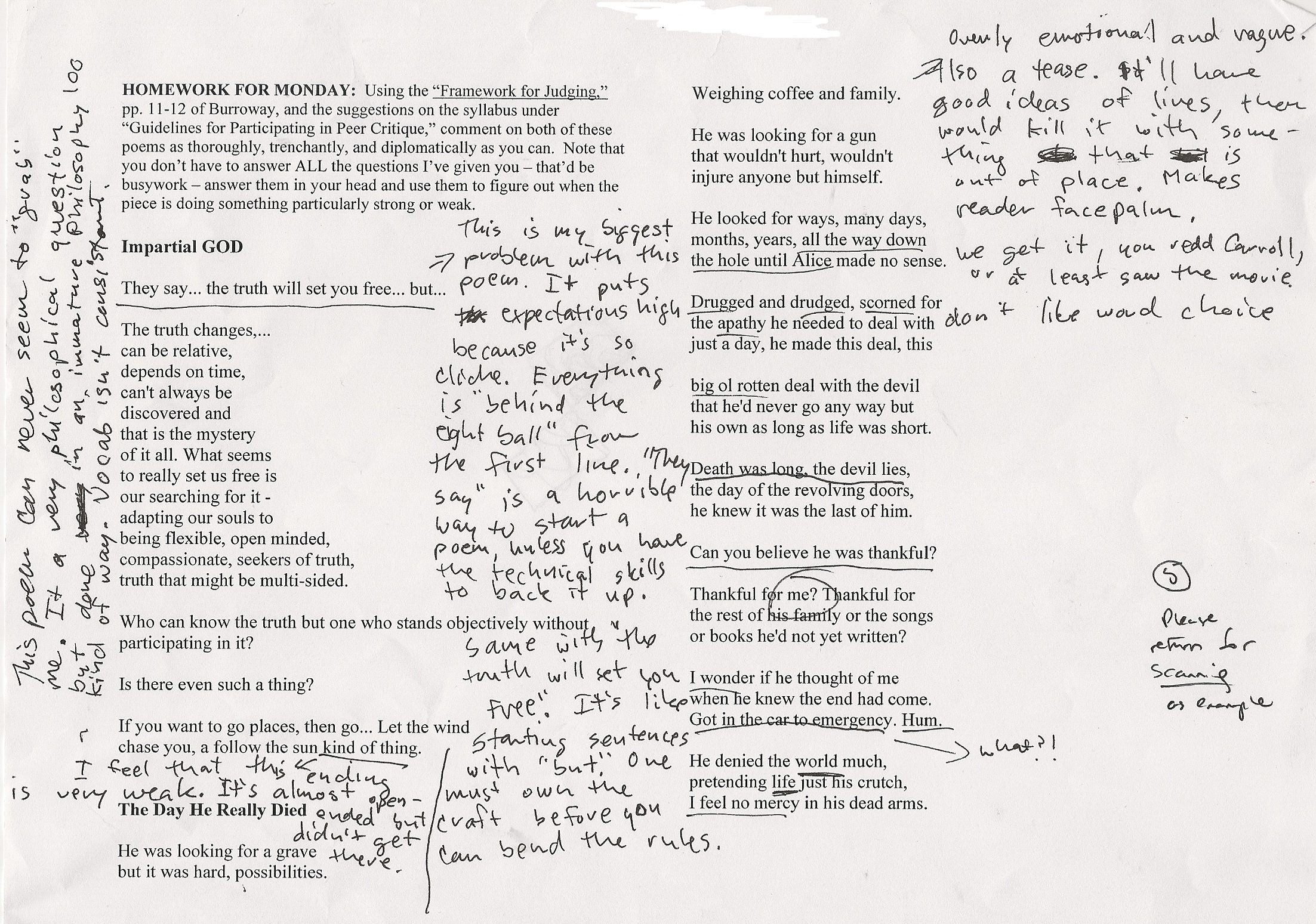
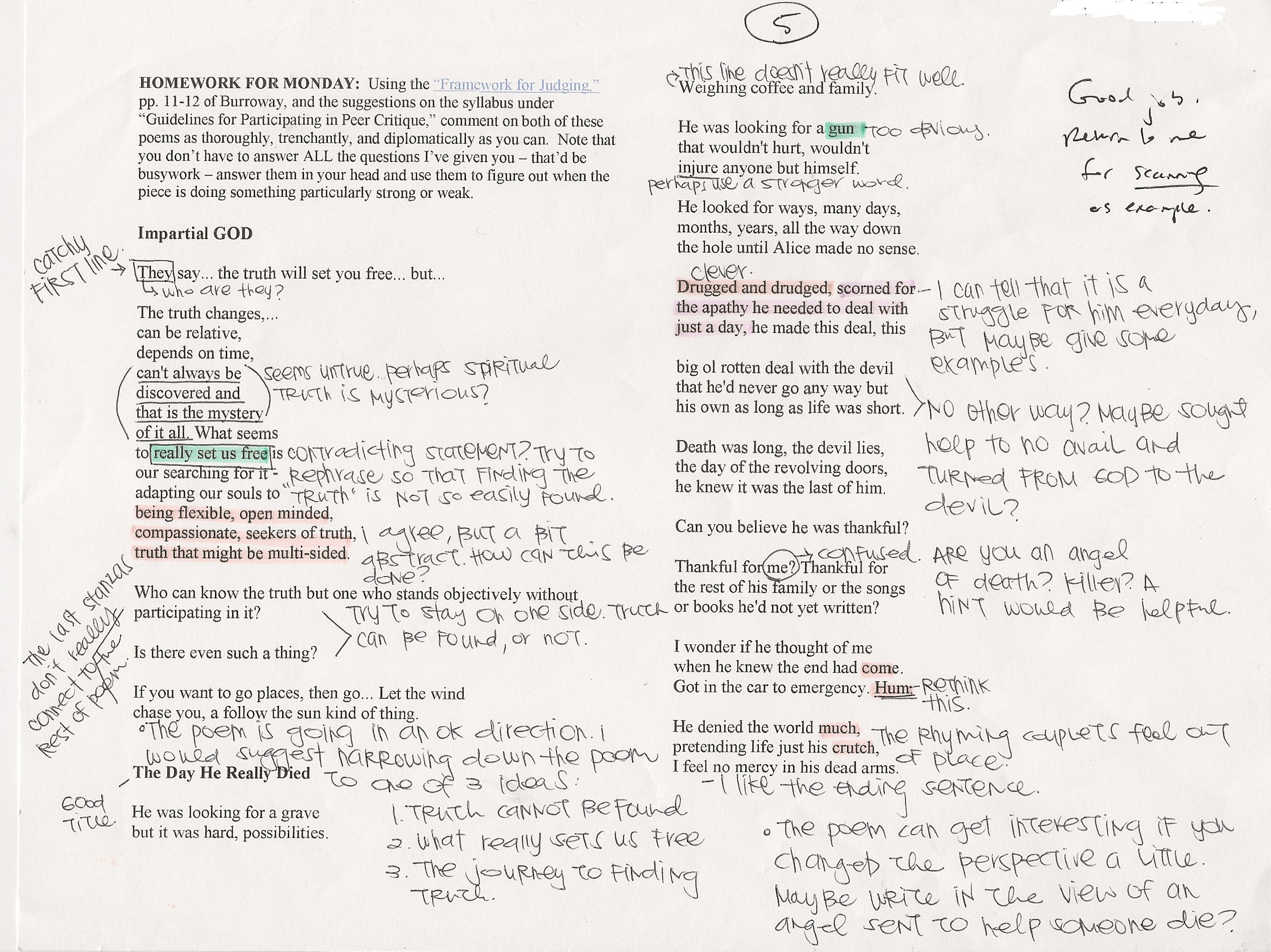
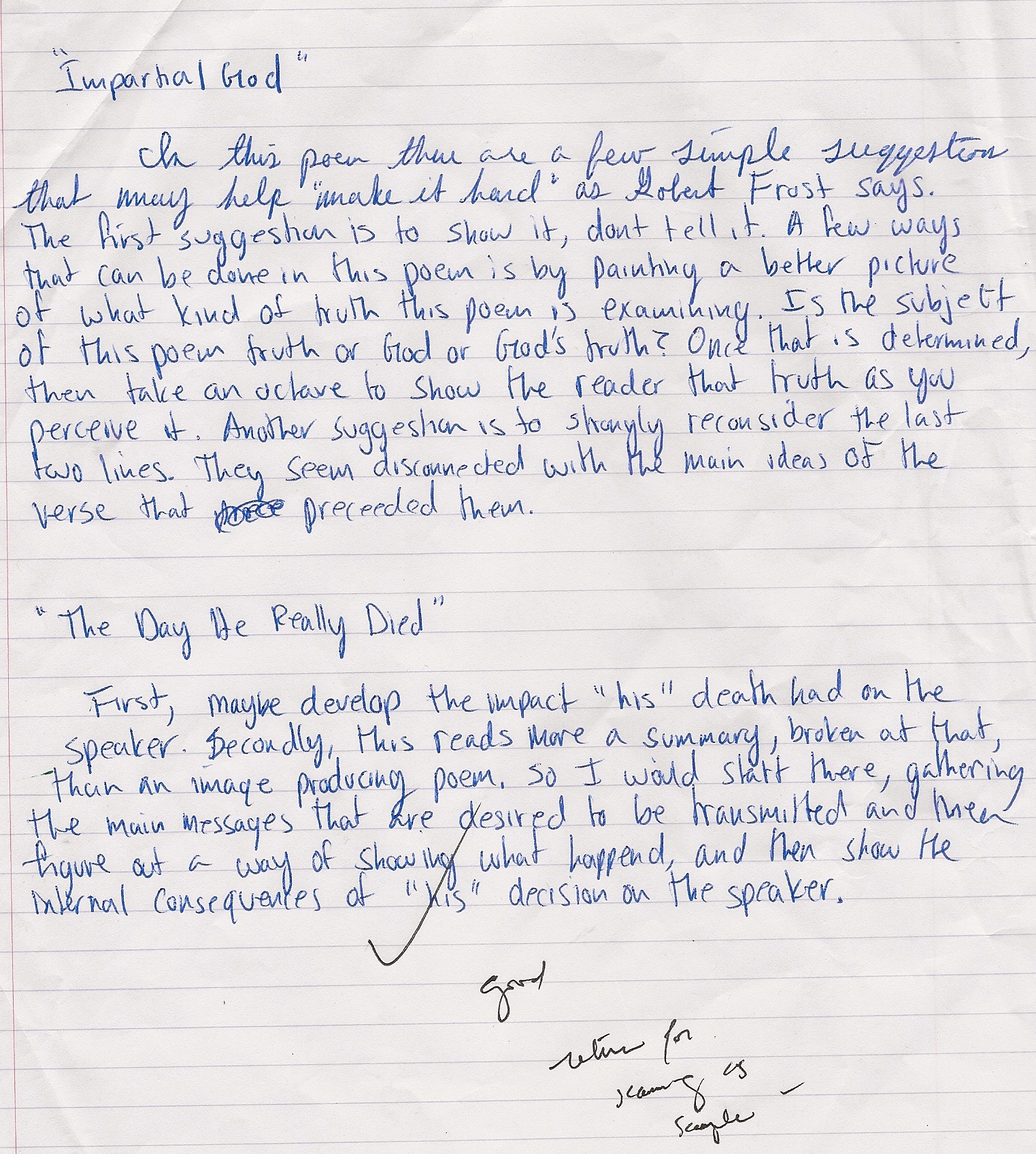
"Impartial God/The Day He Really Died". Sample freewrite.
Negative sample: Pushing to conclusions.
2/1 Burroway, pp. 13-30; "Unaccounted For".
Stages in the Writing Process. Journal:
1.2, p. 7. Concrete, significant details.
HOMEWORK: In your journal, do one of the possibilities in 1.1, p.
6.
2/6 Burroway, pp.
30-46. Plot motifs.
2/8 Burroway, 196-211. Star Bodies.
Idea relationships. HOMEWORK: Read The
Top 10 Relationship Words That Aren't Translatable Into English. Use
the concepts behind one (or more) of these words to get started on a
story or poem about a relationship between two people (note that it does
not necessarily have to be a love relationship; ex. "ilunga";
"mamihlapinatapai."
2/9 Add/Drop deadline
2/13 Burroway, pp.
211-229. JOURNAL EXERCISE: Memory
exercise.
2/15 Burroway, pp. 167-187.
2/20 Presidents’ Day – no
class.
2/22 Burroway, pp. 264-274; First Workshop draft due: noon
2/23 Cauthen reading -- Rosamund Felsen Gallery in Bergamot Station, Santa Monica, 7 p.m.
2/27 WORKSHOPS BEGIN.
2/29 Burroway, pp. 275-290
3/5 Workshop
3/7 Burroway, pp. 87-110.
3/12 Workshop
3/14 Burroway, pp. 111-131. Hockney.
Sense of place exercise.
Vehicle/tenor exercise.
3/19 Workshop
3/21 Burroway, 294-310. Reading quiz on pp.
87-131.
3/26 Spring Break – no
class
3/28 Spring Break – no class
4/2 Workshop
4/4 Burroway, pp. 311-319
4/9 Workshop
4/11 Burroway, pp. 230-241; 250-261
4/16 Workshop
4/18 Burroway, pp. 47-66
4/23 Workshop
4/25 Burroway, pp. 67-86
5/2 Workshop
5/4 Burroway, pp. 132-158
4/30 Workshop
5/2 Burroway pp. 321-349. Journal due.
5/14 Portfolio and Responses due to my office: 5 p.m.